
Why is the Somali bible designed like that?
The Somali Bible: Faith, Culture, and Beautiful Design
The Somali Bible’s cover has sparked conversation. Some people have been surprised, even upset, by its design. But a cover doesn’t change what’s inside. Refusing the Bible because of its artwork is like refusing bread because you don’t like the wrapper. God’s Word remains the same.
Some have noticed that the cover resembles Islamic-style arabesque patterns, which has raised questions among both Muslims and Christians. But the designers did not intend to offend anyone. In fact, this kind of design has its own story.
Christianity and Culture
Christianity has always been shared through local languages and local styles. The gospel is for every nation, not tied to a single culture. That’s why Christianity in Britain looks different from Christianity in Somalia or India, even though the story of Jesus remains unchanged.
The Apostle Paul explained this clearly in 1 Corinthians 9:19–23, saying he became “all things to all people” so that the message could be understood. Same truth — different presentation.
Whose Pattern Is It Anyway?
Those flowing, interwoven designs on the cover are often associated with Islamic art, but they are much older than Islam itself. Similar patterns appeared in Greek, Roman, Jewish, Christian, and Zoroastrian art long before Islam emerged. Early Islamic architecture even drew heavily from Christian traditions, often using the same craftsmen and workshops. The interwoven vine, like the one on this Bible cover, carries deep biblical associations.
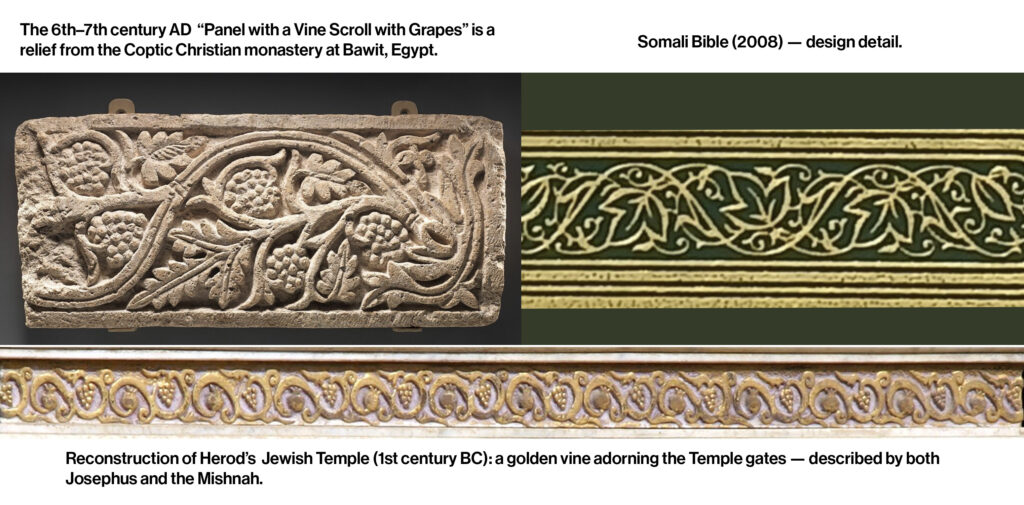
Those flowing, interwoven designs on the cover are often associated with Islamic art, but they are much older than Islam itself. Similar patterns appeared in Greek, Roman, Jewish, Christian, and Zoroastrian art long before Islam emerged. Early Islamic architecture even drew heavily from Christian traditions, often using the same craftsmen and workshops. The interwoven vine, like the one on this Bible cover, carries deep biblical associations.
Using an arabesque-inspired pattern on a Somali Bible doesn’t mean Somali Christians are adopting Islamic practices or compromising their faith. It is a decorative choice, selected for its beauty and a style some Somali people love.
Ultimately, those interwoven vines on the cover, whether people like them or not, can serve as a reminder of “the true vine”: the Lord Jesus Christ, whom we must remain connected to in order to truly live. The gospel is open to people from every culture.
“I am the vine; you are the branches. If you remain in me and I in you, you will bear much fruit; apart from me you can do nothing. If you do not remain in me, you are like a branch that is thrown away and withers; such branches are picked up, thrown into the fire and burned. If you remain in me and my words remain in you, ask whatever you wish, and it will be done for you. 8 This is to my Father’s glory, that you bear much fruit, showing yourselves to be my disciples.
Holy bible, John 15:5-8
As Tertullian, an early North African Christian, wrote: “Christians are recognised not by nationality or customs, but by how they live.” They can participate in local culture while still remaining “citizens of heaven.”
In this way, the Somali Bible is more than a book with a pretty cover. It is a reminder that Christianity can embrace local art and culture without changing God’s Word. Covers may vary, but the message of Jesus remains the same — for all peoples, in every culture, and in every language.